
In precast concrete manufacturing, overhead cranes play a key role in maintaining efficient, safe and consistent production. Components are heavy, lifting cycles are frequent and precise load control is essential to protect personnel and product. Designing a system for this environment requires consideration of structural demands, operational workflow and reliability.
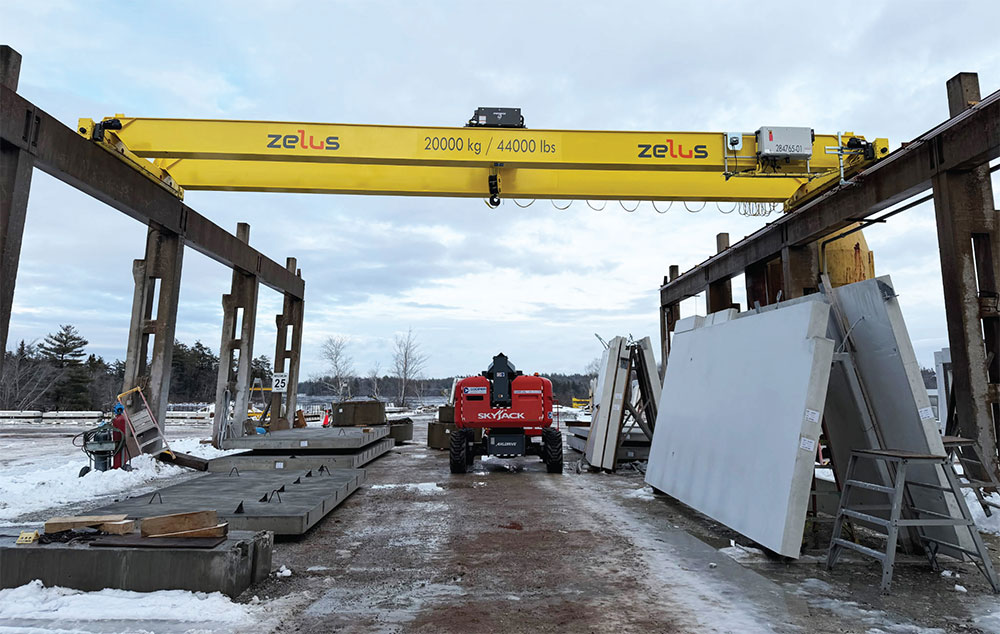
Zelus Material Handling recently completed the design and supply of a 20t, top-running, double- girder overhead crane for a precast concrete manufacturing facility in Atlantic Canada. The crane was engineered to support demanding production requirements while meeting applicable safety and performance standards.
Application driven design
The manufacturing environment required a crane capable of handling large precast components with stability and precision. Load weights approach the upper capacity range on a routine basis, and crane motion must remain smooth to prevent load swing and minimise handling time.
During the design and approvals stage, the customer communicated a critical operational requirement. The new crane needed to match the performance characteristics of an existing Kone crane already operating in the facility. The plant routinely performs multi-crane lifts for large bridge girders, with five overhead cranes sharing the same runway. To safely execute these coordinated lifts, all cranes must operate at matching speeds.
The customer provided detailed specifications for the existing crane, allowing the Zelus engineering team to review and compare operating parameters early in the design phase.
This comparison identified that the initial Zelus design, which featured VFD-controlled travel speeds of 100ft/min, did not align with the required 165ft/min operating speed of the existing crane.
Based on this feedback, the crane travel speeds were revised during the engineering phase to ensure full compatibility with the customer’s fleet. This adjustment ensured synchronised crane motion during multi-crane lifts, meeting the customer’s expectations and supporting safe, efficient handling of long and heavy precast components.
By incorporating this requirement early, Zelus delivered a crane that integrates seamlessly into an existing multi-crane environment rather than operating as a standalone system.
Structural configuration and standards compliance
The final design features a top-running, double girder crane with a span of 51ft 3in. The crane was built to CSA requirements and classified to CMAA Class C, making it well-suited for frequent lifting cycles in a production environment.
A double-girder configuration provides the stiffness and stability required for heavier loads while supporting smooth trolley travel.
Structural components were engineered to control deflection and maintain alignment over time, contributing to long-term performance and reduced maintenance demands.
Direct-drive end trucks were selected to improve efficiency and reliability. By reducing mechanical complexity, this approach helps minimise wear and supports consistent crane motion throughout the system’s service life.
Hoisting system and load control
The crane is equipped with an R&M electric wire rope hoist mounted on a low-headroom trolley. This configuration maximises hook travel within the available building height, a key consideration in many precast facilities.
Smooth hoist operation is supported through precision drive control, allowing operators to position heavy loads accurately and safely.
Integrated overload protection using strain-gauge load sensing ensures lifts remain within rated capacity, enhancing safety and protecting crane components.
Operator controls and safety features
Crane motions are controlled using variable frequency drives on the bridge and trolley, providing soft acceleration and deceleration.
This level of control reduces load swing, improves handling accuracy and supports safer operation during complex lifts.
Primary operation is achieved through radio remote control, giving operators flexibility and improved visibility. A pendant control is included as a secondary option, ensuring redundancy and operational continuity.
Safety systems include two-step bridge travel limit switches that allow controlled slowdown before final travel limits are reached. These features help prevent over-travel while maintaining smooth crane operation and compliance with applicable standards.
Installation assistance and commissioning
Following shipment to site, the crane was installed by the customer’s team with Zelus’s supervision. This approach allowed for efficient installation while maintaining oversight of critical alignment, electrical and mechanical assembly steps.
Zelus supported final commissioning, including load testing and verification of all crane functions. Testing confirmed that the system met design specifications, safety requirements and operational expectations before being released for production use.
Built for demanding environments
Precast concrete manufacturing places unique demands on overhead crane systems. Equipment must be robust, reliable and precisely controlled to support daily operations without interruption.
This project demonstrates Zelus Material Handling’s ability to deliver custom-engineered crane solutions tailored to demanding industrial environments. By aligning engineering decisions with application needs, the resulting system provides a dependable lifting solution designed to support productivity, safety and long-term value.


