
If anyone tells you that they set out with a meticulously crafted plan for their career and it all came to fruition, it might pay to take whatever else they say with a large pinch of salt. Most careers are built on aptitude, application, opportunity and a little luck. Jim Goodall, currently managing director of pewag USA, would be the first to confess that his track record of success in companies both small and large across different industries was not sketched out in detail during his college years, but emerged from his ability to take risks, build relationships and look one step ahead.
A growth-focused and accomplished leader who has proven his ability to drive revenue growth and expand the customer base of every company of which he has been a part, he can certainly build and implement strategic plans for future success, but he always remains open to what is new, unpredictable and unexpected.
“Every career move I have made was a case of taking a chance on my ability to do more than was expected of me,” he explains. “I have always said yes when an opportunity came along. Did I always know how to do it? No, but I had faith I would figure it out and I always made it all work. It was the same with my current role. I had impostor syndrome when I first started because I did not have that much international experience, but I knew I could do the job.”
From the roadhouse to pewag
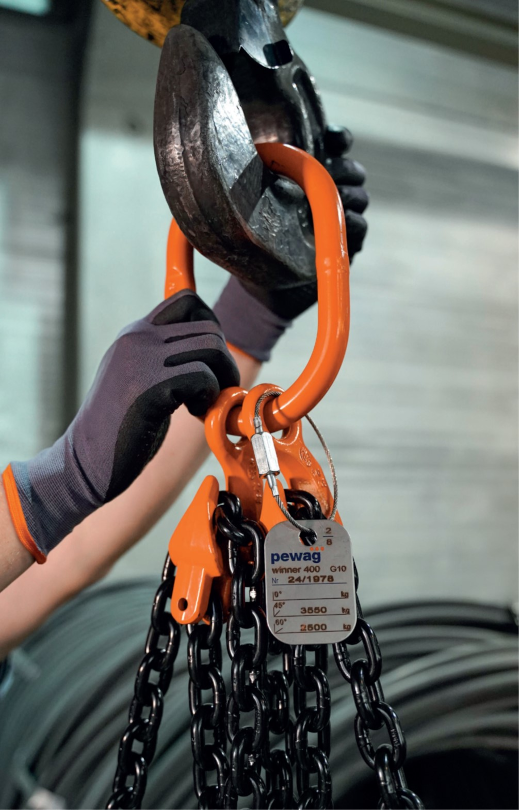
Goodall took up his first position at pewag USA as VP of sales back in 2022. The Austrianheadquartered company has a history that can be traced back more than a century. Though its roots can ultimately be traced back to the first forging plant in Brückl, Austria, in 1479, the modern brand was established in 1923 following the merger of production plants in Graz and Kapfenberg. It remains one of the world’s oldest and most prominent manufacturers of high-quality chains and components, and its primary specialisation is in engineered chain products – snow chains, forestry chains, lifting/lashing chains, tyre protection chains and conveyor systems for various industrial applications.
This is a far cry from Goodall’s first steps into the workplace, which saw him involved in handson rigging roles in the entertainment industry.
“My high school aptitude test said I was likely to be a park ranger, which made sense because I had been a boy scout and an eagle scout, but I actually ended up going into electrical engineering at first,” he says. “I had a strange fascination with lighting and rigging and I ended up working backstage at a roadhouse. I was setting up and taking down sound and light rigs in bars where new shows were being built and taken down every night.”
“At first, I just wanted a really cool job then later I was thinking it would be good to get into working with that kind of technology as it evolved. For a while, I wanted to train to be an engineer, but I realised that wasn’t for me and I didn’t want to be in that environment for years. Entertainment rigging was a very makeshift process at first, but that industry developed a lot from the time I got into it in 1995 when I was in high school. Back then we were in rock climbing harnesses 150 feet up in an arena roof with nothing but concrete beneath us. As I got older, I realised I didn’t need to be doing that every day.”
What followed was a degree in public and corporate communications from Purdue University, though it was not long before Goodall was back in the entertainment lighting world working for production companies putting on corporate events. With a cleaner and classier workday than being backstage at the roadhouse, the job still had the excitement of being involved in a dynamic industry.
Indeed, Goodall’s passion for that industry saw him take up a position as director of operations for RGB Lights, later becoming its vice president. The company specialises in the design, manufacturing and supply of modular, dynamic LED lighting systems. The move allowed him to become more involved in architectural lighting solutions, again thanks to spotting an opportunity and being willing to take a risk.
“I had a passion for the job I was doing but the money was not there. I wanted to be able to travel more, for example, so I felt I needed to make more money. Back then, colour-changing lights were becoming popular and in Chicago, where I live, a lot of buildings were adding colour lighting to their roofs. Companies that were selling those lights came to me to set them up, so I ended up programming eight lights instead of maybe the 1,000 we were used to programming when putting up at an event, but they were paying five times the rate.”
After five years at KSA Lighting and Controls, a leading Chicago-based manufacturer’s representative agency, which specialises in lighting, controls, energy solutions and roadway infrastructure, the call from pewag came, and Goodall took his first steps in the lifting industry.
“From KSA to pewag was a big step. The recruiter said that if I sold one kind of widget I could sell another, and it didn’t really matter what the widget was. The company wanted some manufacturers’ rep experience and some understanding of rigging, which is why the recruiter contacted me. We had done a lot with manufacturers’ reps, and pewag needed a large sales team to sell more into the US.
“When I first joined, I saw the team as a fixer upper. There was a lot of work to do, as the sales force for lifting solutions had not been growing the business as fast as the headquarters in Austria had wanted it to. So, when I came on board I saw the challenge to build the company’s small percentage of market share.”
Culture shock
When Goodall arrived in early 2022, he found an outpost of a company steeped in history and tradition that needed to update its processes and procedures in order to compete in the US market. Although the company had already had a presence in the US for 50 years, it had only focused on lifting solutions for 15 years. Before that, it had largely concentrated its efforts on snowchains and tyre protection chains across a range of industries.
Lifting solutions is still only 15% of pewag’s overall business, but the company has managed to greatly expand its revenue from hook-toload crane solutions in the US, largely thanks to Goodall’s drive to spot inefficiencies, take processes back to basics and challenge the kind of habitual behaviour that allows inefficient processes to become ingrained as normal patterns of work.
In a little over four years, Goodall has managed to boost topline revenue up by 30% and that future is still growing. In part, that has come from understanding the benefits and the challenges that come with a business model in which the parent company treats all of its overseas divisions as small, autonomous local businesses. This gives each division significant freedom to determine how it is run.
“I like some structure, so I initially leant on HQ in Austria to learn about the product. The autonomy can risk creating some disconnect, which can create some complacency and that is what I observed in the US team, which I felt lacked a sense of urgency,” Goodall explains.
“Some of the communication was slow, and the company had a culture that might work very well in other countries but was not well-suited to the US, where you need structure, urgency and responsiveness. We are a distribution company, so we need to get products out of the door quickly. I had a lot of work to do tightening up procedures. I found that there was a lot of tribal knowledge within the teams that had built up over time and that needed to be shared across the organisation.”
Major change was required, but it could not be at the expense of disruption to the business. Goodall likens it to flying a plane and having to fix an engine in mid-air because you can’t stop the plane and take it apart. Fortunately, some changes were relatively easy to make. For instance, going back to the manuals to learn how to use software to its maximum capability was a big step forward.
“We streamlined procedures and got everyone to learn how to use software properly, but we also had to update the culture. We want to work in an environment where people are less likely to blame each other for what goes wrong and more likely to help each other get things right.
“Challenging complacency was very important. It took a long time to create a culture where people no longer had a fear of bringing up problems and addressing them, and where the value of helping people to understand problems was realised.”
This cultural shift helped pewag USA get a twoweek shipping time down to 48 hours. Needless to say, customer satisfaction improved significantly. Then a market opportunity opened up that Goodall knew had come at the perfect time for pewag’s more efficient team to exploit.
Two competitors – The Crosby Group and Kito Corporation – merged in 2023 to form Kito Crosby, which has since been bought by Columbus McKinnon. With any merger, there are always issues to resolve to bring different organisations into alignment, and the well-document postmerger issues that affected the combined entity’s logistics operations left Goodall and his team with an opportunity to showcase the more efficient processes they had instilled in the organisation.
“When a competitor could not ship products for a while, we were able to capitalise on that and get more business from some customers who were looking around for alternatives. Since then, we have seen three solid years of growth. We made changes and then the market gave us an opportunity, and the sales team was able to take advantage of that.
“As a small, tight company we can really control our supply chain. The company is all privately owned, and I have a direct line to every manager, so I can get product moved quickly. Also, we stock more than any other pewag facility, so we always have product that is available.”
Finding a home in the hoist industry
Although Goodall is a relatively recent arrival in the lifting industry, he has quickly come to appreciate how it operates and what values lie at its core. Though it serves the needs of many industrial operations, it still rests firmly on personal relationships and the culture of many companies can still be likened to a family.
“I like that it is extremely clear who our customers are – the rigging shops. Some of them are what we call the ‘mom and pop’ rigging shops, though we also work with more regional or national customers. There is a lot of consolidation across the market, and we have spent a lot of time making relationships with the smaller rigging shops, and as they are bought out by the bigger players, we still keep those relationships,” says Goodall.
Some of pewag’s smaller customers have been swallowed up by bigger fish, but the people with whom Goodall’s team has worked will often remain firm advocates for what pewag can offer, and their voices are sometimes heard within the larger conglomerates.
“Last year, we really shifted that focus, and we now have an entirely new sales team focused on conglomerates and online marketplaces, as well as the team that focuses on the smaller shops. I love that in many ways this is still a small and personable industry in many ways and that the business is about the relationships you can build.
“One thing that I would change across the industry is to introduce more modernisation. I am a big tech guy and when I came on board we did not have a CRM. For example, we could not easily get hold of a full customer list, so there was a great tech opportunity and now we focus a lot on building out customer portals and going beyond where most of the industry is at – many orders are handwritten, scanned and emailed, or even faxed to us.”
One key challenge, however, is recruitment. There are not enough skilled people to meet the needs of rigging companies. It is hard to find sales teams with experience, crane operators and technicians. There are simply not enough people who want to do this work, and this is where modernisation could really help. For tech-savvy younger generations, a tech upgrade could make the industry more appealing.
“There is a swing coming. People need to use computer technology even if they don’t have a computer at home, which a surprising number of people do not. They may just use a phone. I feel that I am ahead of the curve in terms of technology use, but then I am constantly looking at things from a five to ten year perspective.”
That long-term strategic view is being challenged by the increasingly unpredictable times in which companies have to operate. Geopolitical factors and sudden economic fluctuations make it hard to predict the future, but companies still have to figure out the best way forward.
“Unpredictability is a real challenge,” says Goodall. “The news changes by the hour and when you are a long-term planner that presents some problems. There is a foggy outlook for the next five years and that comes on the back of a challenging year. Tariffs are a crazy thing, and they came in all of a sudden and no one was sure what to do.”
At first, pewag rerouted all inbound freight to Canada to avoid paying millions of dollars in tariffs and so began the ‘Canada drip’ of steel coming into the US as and when it was needed.
“Then tariffs on steel were reinterpreted and redefined, and we have had to learn a lot very quickly about international trade and customs,” says Goodall.
Perhaps the only certain thing in the industry’s future will be more consolidation, particularly as more venture capital money comes in. New products, more automation and an increased focus on safety systems will also be key trends, as the industry takes more opportunities to remove workers from dangerous tasks working near a load.
“That is a good thing for the industry. We are not replacing workers, just moving them away from the danger zones. Automation is not so much about replacing people. I don’t think manual labour will go away in my lifetime.”
It seems this is an industry that will remain firmly based on people, the relationships they form and the culture of the companies that work within it. Those things are firmly in Goodall’s wheelhouse, which is why pewag USA has become an exemplar for the rest of the company.
“Culture drives performance, not the other way around. Everything I have done has focused on the culture of the company and taking a positive approach internally to whatever is happening in the world rather than slipping back into the culture the way it was. We are pushing more practices back to the parent company in Austria and we have become the example of how distribution should be run. It is all about getting away from entrenched thinking.”
Goodall may not have grown up in this industry, but he clearly understands how it works.


