

Manufacturers that offer a line of below-the-hook equipment might supply a range of products designated as being ‘mill-duty’. The term is widely used in industry to describe equipment engineered for the most demanding environments. In essence, it denotes equipment that is as hard as nails, built to take relentless punishment day in, day out, without flinching. This type of product is also described as being ‘severe-duty’ in some sectors.
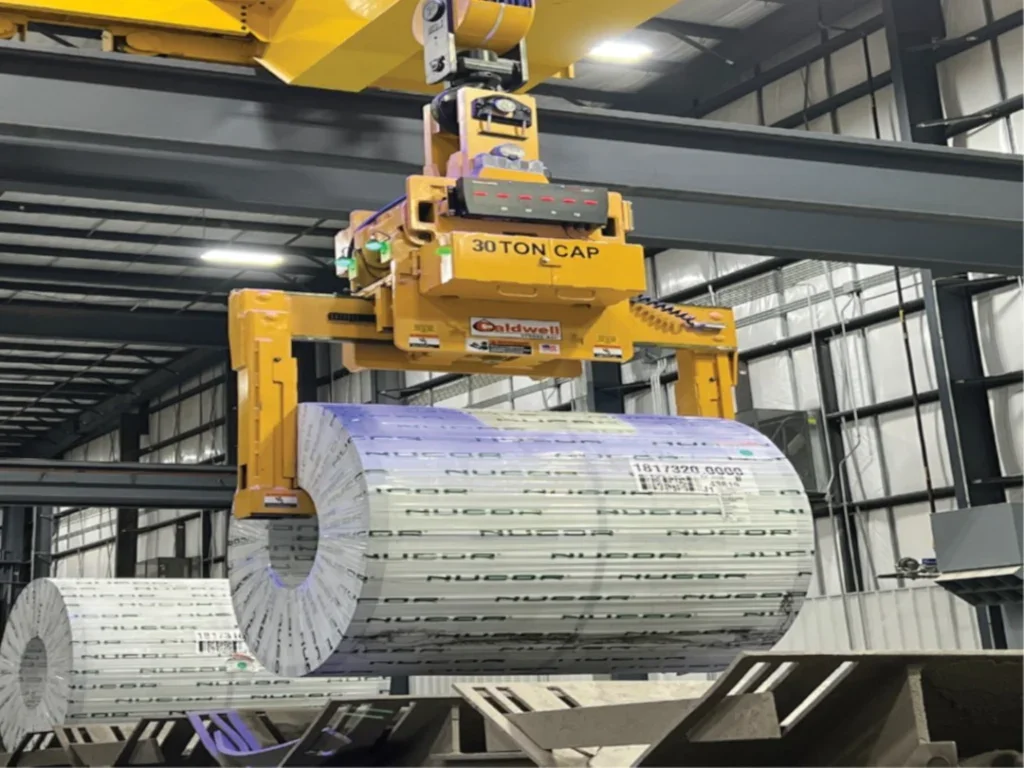
These lifters are made for frequent, high capacity handling of heavy loads under harsh conditions, such as those you might find in steel mills, foundries and heavy manufacturing plants. In a recent application, a 37.5t capacity mill-duty coil grab was installed below-the-hook of a 40t capacity overhead crane. The grab carries coils from the processing machine to a floor storage area, over a distance between 100–200ft.
It will depend on the manufacturer, but mill-duty conversations at The Caldwell Group commonly revolve around four product groups, each of which has what you might think of as a standard-duty little brother or sister, but is engineered and manufactured in a way that suits it to use in the most severe environments:
- Coil handlers
- Sheet plate handlers
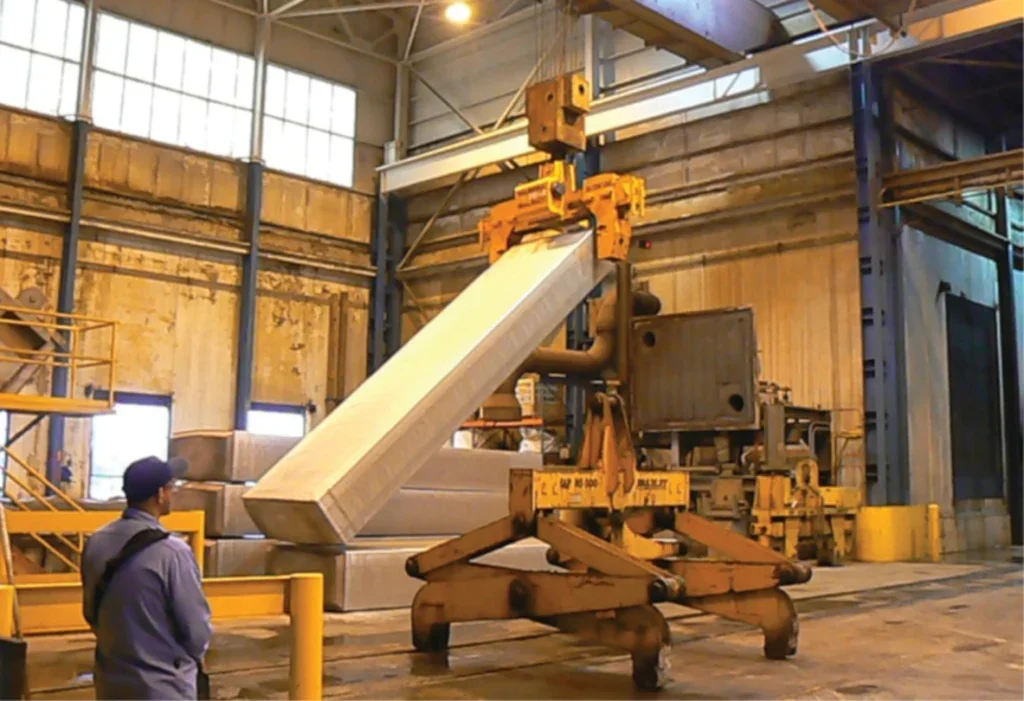
- Ingot, slab tongs
- Lifting beams, including magnet and vacuum attachments.
While mill-duty is not a formal standard designation, it is helpful to think of it as meeting American Society of Mechanical Engineers (ASME) B30.20 BTH-1 Design Category B, Service Class 4, which means these products are engineered for heavy, repetitive use in demanding environments. They are, therefore, likely to feature reinforced steel construction, oversized parts and components that can withstand vibration, heat and abrasive materials.
Another tangible reference point is the electric overhead travelling (EOT) crane and hoist that the mill-duty lifter will be attached to, which is always central to the conversation when sourcing such a product. Oftentimes, Crane Manufacturers Association of America (CMAA) Class D is in play when talking about rugged below-the-hook equipment, which refers to a heavy-service overhead crane duty classification. This is used to define how intensively a crane is expected to operate over its life.
These ASME and CMAA references point to the likely applications where mill-duty lifters will be required. However, while these classifications provide a useful technical framework, it is the application environment at the point of use that ultimately determines the specification. Heat and duty cycle are primary factors that will dictate whether a standard design is sufficient or whether a more robust, mill-duty solution is needed, reinforcing that correct product selection depends less on labels and more on a detailed understanding of the working conditions in which the equipment must perform.
Lifting systems
Even when the phone rings from an end user or supply chain partner requesting a mill-duty lifter, the conversation is always brought back to the fundamentals of the operating environment, starting with the type and capacity of crane or hoist, and how it is operated and controlled. It is never a case of adding an item to a cart and heading to the check-out. This is because, at the upper end of duty, the lifter cannot be considered in isolation; it is part of a system where load spectrum, cycle rates and control characteristics all influence performance and safety.
By contrast, when discussing other equipment from a material handling manufacturer’s catalogue outside the mill-duty range, the specifics of the crane and hoist tend to be far less critical, as the application demands are lower and the margins for variability are greater. ASME B30.20 BTH-1 Design Category B, Service Class 2 might be on the table in these instances.
If a customer from a steel mill is requesting a product that clearly cannot meet the rigours of their application, the manufacturer must work back up the specification scale. This means reassessing the lifter’s design category, service class and compatibility with the crane or hoist, ensuring the selected solution can safely handle the load spectrum, cycle frequency and harsh environmental conditions typical of mill-duty operations. It’s a proactive approach that prioritises safety, reliability and operational performance over simply fulfilling the initial request.
Of course, there might be instances where a standard below-the-hook attachment won’t meet the criteria, nor is a full-spec mill-duty lifter necessary. Largely with steel service centres (facilities that buy steel in large, bulk quantities from mills) in mind, we provide a line of heavy industrial products. While not of the heaviest duty, they are adequate for handling heavy steel plates and coils, moving and positioning them safely and efficiently with robust cranes and hoists, designed equally for moderate volume operations.
Then there are times when a totally customised solution is required, that begin with a blank piece of paper. In these instances, the product might not resemble a coil handler, sheet plate handler, slab tong or lifting beam, and might not even be for material handling, but it meets mill-duty specifications and is engineered for the most demanding environments.
The goal is never to steer a customer towards a mill-duty product if their application doesn’t warrant it. That’s why a reputable manufacturer will gather information about the crane, hoist and enduse environment from the start. By understanding the load profile, duty cycle and operational context, vendors can guide the customer towards a lower-duty specification when appropriate, ensuring the solution is correctly matched to the application, avoiding over-specification and maintaining both safety and performance without incurring unnecessary expense.


