
Richard Warriner likes to wear many different hats. Even now, as vice president of business development at Spanguard Corporation, he also runs his own consultancy business WK2 Services Corp, drawing on his understanding of the need to match skills and experience with the needs of smaller operators. Whichever hat he is wearing at any given time, his focus has nearly always been on the crane industry, to which he has brought an enviably strong work ethic and an eye for innovation.
In his current role, he focuses on supplying, maintaining and expanding specialised electrification systems for industrial applications, including cranes and hoists, an area on which he has focused his mind and his effort for more than 40 years. In that time, he has helped industrial operations solve countless complex power system challenges with practical, fieldproven solutions.
His experience encompasses crane power delivery systems, modernisation projects, infrastructure upgrades, troubleshooting and technical evaluation across a host of industrial environments, and throughout his career he has honed his knowledge of how plant teams, contractors, engineers and manufacturers work. Working directly with Spanguard’s customers and partners he continues to identify challenges and create solutions to solve their problems with a unique blend of experience, collaboration and understanding of how systems actually work in the field.
This is a long way from the path he might have followed, had he been persuaded to join the family business.

“I have always enjoyed meeting people and working, and when I was growing up my dad was in sales, and he wanted me to follow in his footsteps,” Warriner explains. “He worked for a wholesale distributor of ladies’ hosiery, but things were changing in that industry at the time. One of the nylon manufacturers came out with a new model of merchandising in retail establishments on consignment, so it was not an area where I felt I could compete.”
Having moved out of the hosiery business, Warriner took a job managing manufacturing operations for commercial chemicals for a while, but an auto accident put him out of action for four months and he lost the job. Soon to be married and wanting to start out that stage of life on the right foot, he took a sales training opportunity that would put him on a long and varied path through the crane and hoist industry.
Taking chances
The opportunity was with American Monorail, a manufacturer of patented track, a specialised, engineered composite rail system used for overhead cranes and monorails in place of standard structural steel beams. It comprises a hardened, raised tread that is often made of highcarbon steel and offers superior strength, reduced wheel wear and lighter weight per section for similar load capabilities.
The company, which is now TC/American Monorail since the 1990 merger of Twin City Monorail and American Monorail, was then building monorails and some bigger cranes up to 20t capacity, and Warriner was part of its sales team.
“Now I sell to crane companies, not for them. I have always had an aptitude for sales, and I think that comes from enjoying studying people. I have always enjoyed that. It is an interesting subject, which is why I really enjoy in-person meetings rather than the online experience that we have today. I like to be able to read body language, which is not really possible over the internet. I know what it means when I see people crossing their arms, gritting their teeth, stepping forward or back.”
That instinctive understanding of people has stood Warriner in good stead throughout a long and varied career. The next step was for the company to put him in the field, so he spent some time as a sales engineer in Philadelphia. When he left, it was to take up a role at prominent manufacturer Euclid Crane of Cleveland, Ohio.
The Euclid Crane & Hoist Company, founded back in 1909, was the precursor to the renowned Euclid earthmoving equipment brand, which was initially focused on cranes and hoists and then evolved into a major off-highway truck and scraper manufacturer before that division became part of General Motors in the 1950s. Some vintage industrial Euclid crane components, including switches and controllers, still appear in industrial marketplaces.
Euclid Crane was bought in the 1970s by Kranco Crane Services, which acquired Euclid’s advanced gearbox design and power plant crane technology. The combined company became Kranco-Euclid, which was later acquired by Konecranes in 1993, and now provides OEM parts and support for Euclid cranes.
From there, Warriner went to work for Morgan Engineering as sales manager. The company had a long history dating back to 1868, and up to today has designed and manufactured more than 30,000 cranes, and it holds thousands of patents and designs using edge-cutting innovations and technologies. Again, Warriner found himself in an organisation with a rich history that was the ideal place to learn about the industry and its appetite for innovation.
Spells at Canada Pacific Railway and Ace World Companies followed, and at the latter Warriner rose to be VP of business development before becoming regional manager for Foley Materials Handling in 2002. Led not by a carefully planned strategy but by fate and opportunity, he took the chances that came his way and, in doing so, built a vast bank of expertise and experience.
“I had no plan, I took the opportunities that were presented at the time, and as I became more familiar with the industry and its intricacies I learnt about many different companies and saw there are always opportunities that will open up.”
Twists and turns
Virginia-based Foley Materials Handling, founded in the mid-1970s, designs, manufactures, installs and services custom overhead cranes, gantry cranes, hoists and automated storage and retrieval systems. The company specialises in heavy-duty machinery for industries like railroads and steel, along with modernisations, crane inspections and custom components.
In its early days, it was heavily involved in the Cleveland Tramrail patented track monorail and crane systems that founder Dale Foley would design and install with a small crew of employees. Then came the design and manufacture of single girder cranes, which provided a solid platform for growth. Warriner was again able to be part of a company with a rich heritage, and that would become a theme throughout the years that followed.
He spent different stints at Ace World Companies, including time as VP and general manager, before returning to Foley, which had established its Virginia Crane brand in the 1980s when it began manufacturing box girder cranes. There, he was responsible for sales, service and project management across Southern tier states in the US as well as Mexico and Western Canada.
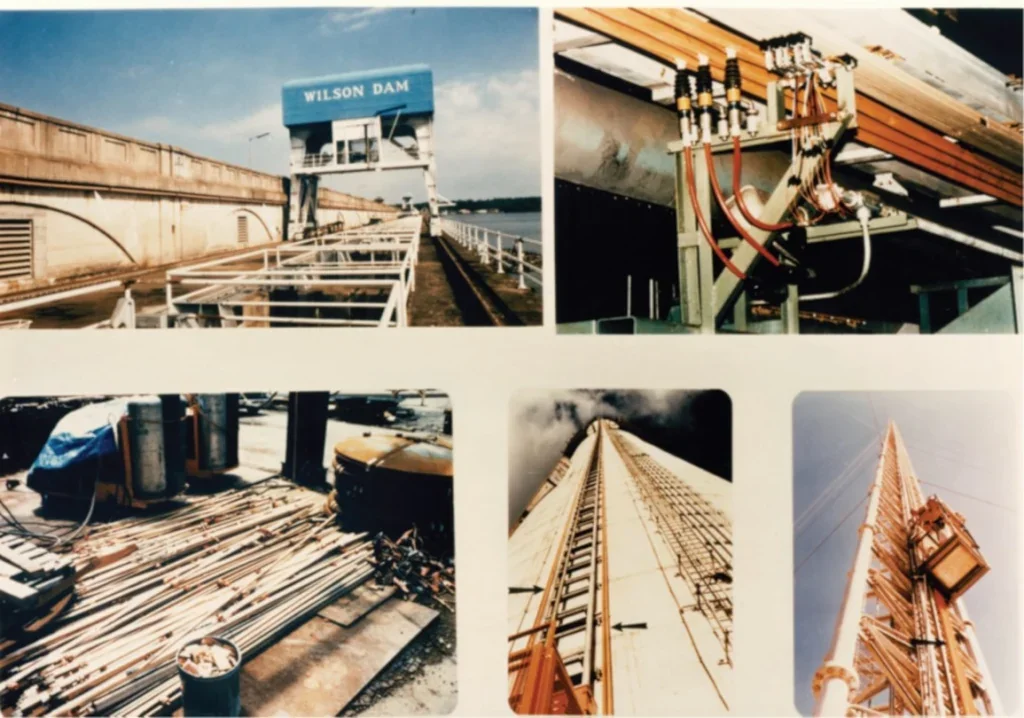
Later, from 2012 to 2015, he would work for Flow-in-Motion, a North American distributor specialising in mechanical and electromechanical systems and components for cranes and industrial applications for industries such as steel, mining, automotive and pulp and paper. By 2021, he was working as director of business development at Rack N Roll Marine, bringing to bear more than 40 years’ experience on its material handling and warehouse storage solutions. Then came the call from Spanguard.
All of this may seem like a fluid and wellplanned career progression, but it was anything but. As Warriner says, he never had a plan, and sometimes life takes unexpected turns that shape everything from a career to a home life.
“Not all the steps in my career were vertical ups. Sometimes you need to take a step back and take stock. When my wife got ill with cancer, for example, I decided to leave Ace. That was the hardest experience of my life, and after she died, I came back into the industry in a new role with Foley.
“Dale Foley had kept in touch and said if I wanted to come back there would always be an opportunity. When I did return, it was with a new perspective on what is important in life. Different companies have a different outlook on things.”
For Warriner, this is an industry that will always be about people rather than just numbers.
“I see big international companies coming into the US wanting to be the largest in the world, but I look at things differently. They look at the numbers, but I look a bit deeper into what is behind the numbers. When you don’t do that, something is lost along the way.”
Recognising the value of experience
During his time with the Spanguard, Warriner has been a key driving force in its expansion, including the acquisition of the former U-S Safety Trolley range from Legrand Corporation. In his current role, he works with industrial operations, distributors and technical teams to identify their power delivery challenges and help them to implement solutions that improve reliability, safety and long-term system performance.
Above all, Warriner is a font of knowledge about modernisation planning, infrastructure upgrades, product selection and strategic support for complex material handling environments. This is in no small part because he has understood the value of people and has always taken a keen interest in understanding what makes them tick.
“Above all, my career has been defined by personal relationships. I have had many opportunities to work with and learn from people, though I have always made sure that when I make a mistake it is my mistake, not theirs. I’ve met so many people along the way and while some lessons have been forced on me, many have come just from getting to know people.
“Yes, I am always looking for opportunities, but I have not necessarily been planning for it. Learning to plan and organise my thoughts has been a really important skill. For example, Charlie Kozak at American Monorail taught me a lot in the early days about how to review opportunities and how to understand what is valid and what is not.”
With such a varied and storied past in this industry, Warriner is well-placed to take a view on how it will develop in the future. Understandably, he sees technology as a major driver with automation playing an ever-greater role in how lifts are managed.
“Automation is becoming more and more involved, and technology in recent years has come along to enable you to automate an overhead crane with a load hanging on a hook, managing how the load behaves as it accelerates and decelerates. You can take out the human factor and understand how to use equipment in the most efficient way. There have been some tremendous advances in efficiency, and there will be more. There is a lot of technology that has made lifting much safer.”
The industry to which Warriner has given his working life has given him a lot in return, and he remains excited about its future. It has allowed him to learn not only about the lifting industry itself, but also the many different sectors that rely on crane technology as a core part of their operations.
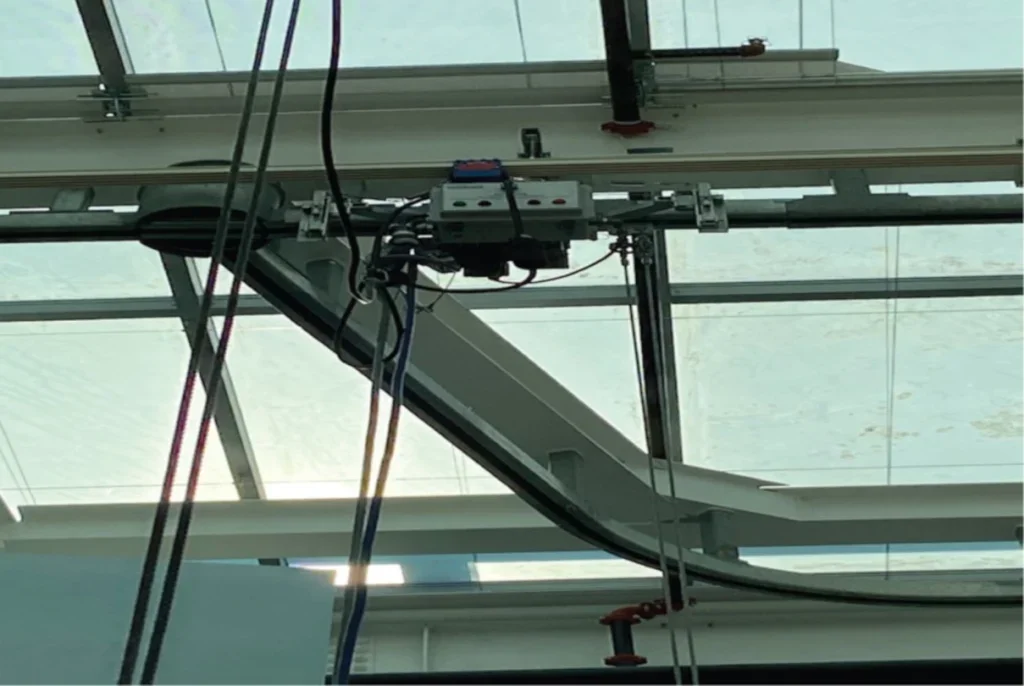
Just recently, he has been looking at implementations of Spanguard’s Four-Bar conductor bar system that has been designed for electrifying cranes, hoists, monorails and moving equipment and came into the company’s portfolio when it was acquired from Starline Holdings in 2024.
“I really enjoy it because I have an opportunity to see how things happen. Four-Bar lends itself to monorail systems, and one customer has several units in its manufacturing operations. Last week, I was on a manlift in Brunswick, Maine, inspecting a Four-Bar system that is being used on aircraft hangar doors. I’ve seen steel-making operations using 250t capacity cranes, I’ve been in nuclear power plants looking at their overhead cranes and I have seen a lot of materials handling operations. It is always fascinating to see.”
His love for the industry does not, however, blind Warriner to its shortcomings or its challenges. One thing that he wishes would change is the apparent loss of knowledge among some companies that buy and use lifting equipment.
“When I was a youngster coming up in this industry – and even up to 2000 – there were experts in the industries we sold to. Companies would have a cranes guy, and he could make decisions based on knowledge. One thing that is frustrating and makes me sad is that now these decisions are often made on price rather than value. Sometimes corporations get so big they don’t really understand the details.”
Banking on experience
It is Warriner’s appreciation for skills and experience that has led him to his parallel venture – WK2 Services. This is a technical services company that provides hands-on expertise for industrial crane power systems and other related infrastructure. The W is for Warriner, and the K is for Daniel Klasel, president of Spanguard and VP of WK2 Services.
The company was established to address growing industry demand for experienced field knowledge, particularly in modernisation projects and system transitions, where practical experience counts but is often in short supply. The company works directly with facilities, contractors and technical teams to evaluate systems, identify risks and create reliable solutions to improve performance, safety and long-term operability.
“The service industry is primarily composed of lots of ‘mom and pop’ shops. They may have good technicians but no engineers and people who are retiring from that role often want to keep using their skills but not in a full-time job. So, we took the WK2 proposition to the market. We are not an engineering firm, and we can’t provide licensed people directly, but we can match experienced engineers with opportunities presented to us by small service companies. It is almost like a brokerage, matching opportunities with appropriate engineering expertise.”
Over the years, Warriner has clearly kept up with the changes that have happened in the industry, and WK2 is the result of his deep understanding of the skills deficit that casts a long shadow over it. The company grew from an idea that was fertilised by decades of hands-on crane electrification and modernisation experience, including Warriner’s participation in ASME, AIST and related code committees. That experience gives WK2 an in-depth understanding of industry standards, as well as a field-tested perspective on what makes crane service teams able to plan work correctly and confidently.
It is also the fruit of Warriner’s almost insatiable appetite for work.
“My wife would argue that I don’t have a balance between work and the rest of my life. I am more work-driven than most people and I have a real need to achieve. Satisfying a customer or winning a contract is what pushes my buttons.
“I think that comes from growing up in a culture where you were expected to work. Somewhere along the line, I decided I had to be able to take care of myself and my own life, and the result is that I probably focus more on work than I should. But I understand what drives me. When I remarried, I knew that I would have a wife that is as supportive as anyone could be, including my first wife, who always understood my need to work.”
If there are any parting words of wisdom that Warriner has for the next generation in this industry, it would be to value skills and experience, to understand human relationships and to reward bold and decisive action when it is taken.
“Praise people for taking the initiative and they are more likely to do so again. It gives people confidence when you praise their abilities and their initiative.”


