
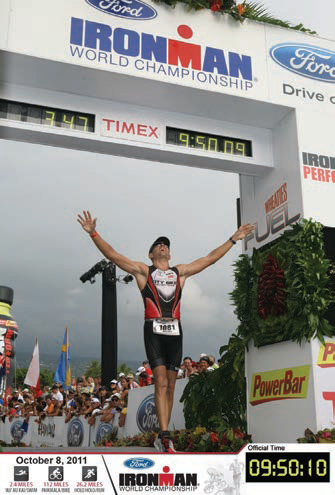
By his own admission, Miguel Tellez is a man who follows his heart, and when he dedicates himself to something there is no holding back. Whether it is competing in Ironman championships, setting his personal best marathon time at the age of 50 – an impressive two hours 43 minutes – or following his then girlfriend and now wife to another continent, he has never shied away from a challenge.
“I am a passionate person,” he says. “If I do something, I do it 120%. For me, 110% is not enough. I do everything to the full. When an opportunity presents itself, I step forward. I am the one who volunteers.”
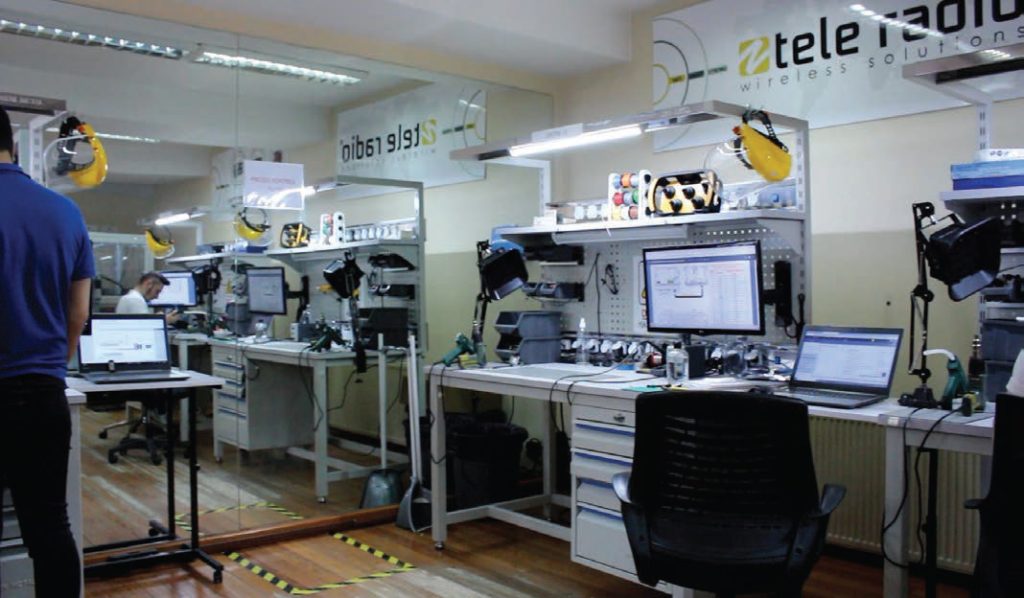
Now in charge of one the leading suppliers of radio control systems to the North American industrial lifting sector, Tellez has come a long way from his native country of Spain. Along the way, each step – large or small – came from his urge to stand up and be counted when a new challenge arose, and his willingness to back himself to succeed even when he was stepping into the unknown.
That is not to suggest that he has no foresight. In fact, he knew some things for certain from a very early age.
“I have a very clear memory of when I was eight years old, and I was asked what I wanted to be when I became older,” he explains. “I said that I wanted to be a mechanical engineer, and that is exactly what I became. But then life throws unexpected things at you, and you have to be able to adapt.”
Taking chances
For Tellez, the unexpected was a strong force that shaped his career right from the start. Having studied mechanical engineering at the University of Zaragoza, he was only able to put those skills to work for a few weeks before being asked to step into something outside of his core skill set. His first job was at tower cranes manufacturer Metalbo in Zaragoza, where he started work in1998, ending up as sales manager before moving on in 2000.
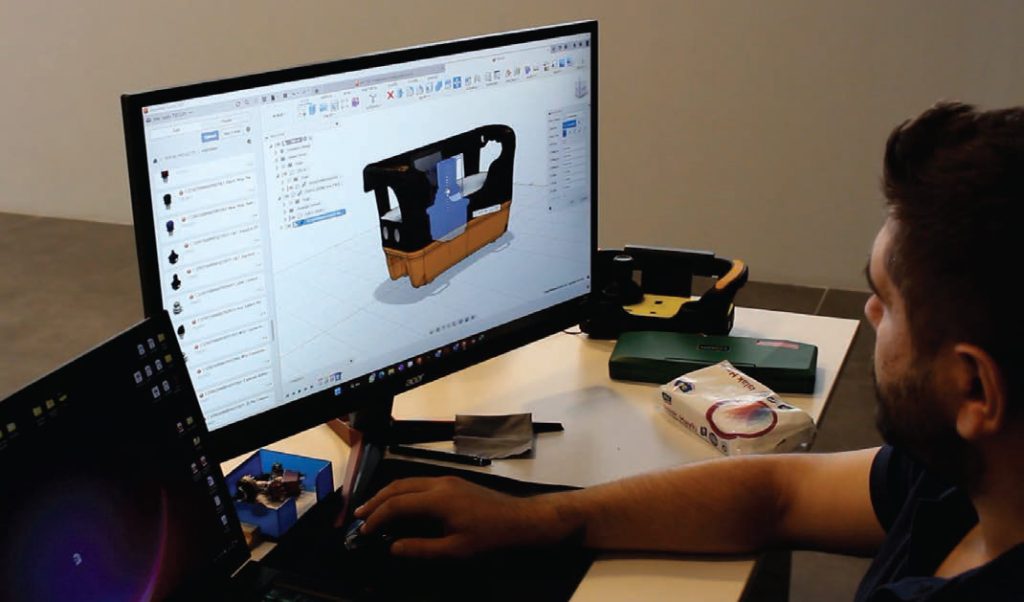
“Out of college, I worked as a mechanical engineer for exactly three weeks, working with another engineer to design a tower crane,” he explains. “At the start of the company, we had three engineers working in different disciplines, but the electrical engineer soon left, and I was asked to take over that role.”
“It was not what I had studied, but my father had a workshop and throughout my childhood I cleaned the floor and worked in it, learning about electrics and cars, so I stepped in,” he adds.
“So, I found myself in charge of electrics and electronics. Then we needed a sales person to sell what we had designed, and again I was the one who stepped in.”
Soon, Tellez found himself as the sales manager in a very family-oriented company, and this way of working as part of a close-knit team would influence his approach to building businesses in the future. Accepted as a key member of that business family, he found himself being offered the position of managing director by the owner – an expression of great trust – but a change in market dynamics meant that move did not come to pass.
As is typical with many start-ups, there were issues with funding, so Tellez moved on to a new company – industrial weighing systems manufacturer and radio remote control systems distributor Motorman. He had developed a relationship with the company through his work on electrical as part of radio control systems, so he had the knowledge and skills to step into this new role, eventually becoming export manager by 2005. “Like everything in life, I was never afraid, or even if I was afraid, I still stepped up,” he says.
During his time at Motorman, Tellez developed his specialist knowledge of radio controls and industrial weighing systems, coming to understand in depth the Spanish, Portuguese and broader European market. His next step, however, would take him away from Europe entirely. Once again, it was the result of him following his heart.
Crossing the pond
In his sales role at Motorman, Tellez was selling a Taiwanese radio control system that was inexpensive, but not as reliable as some customers would have liked. His search for an alternative led him to open talks with Tele Radio. In his role as manager of imports and exports for Motorman, he began reselling Tele Radio systems in Spain.
Learning about the company’s history, he was impressed by how the owner had turned a local Swedish company into a business that sold its products worldwide and was attracted to working for such a successful and expanding business.
Then fate would play its hand.
“Going back 34 years, my girlfriend at the time had moved to the US to study, and we had a long distance relationship while she was away,” Tellez explains. “She came back to Spain after college and we were going to give it a chance there, but really she wanted to go back to the US and she asked me if I would go with her.”
“I asked the owner of the company if that gave us an opportunity to open a subsidiary for the North American market, and he said okay, so I followed my girlfriend to the US,” he adds. “That was 20 years ago, and I have not looked back. I was stepping into the unknown, moving to a new country where I knew no one and nothing about the industry. We were building everything from zero.”
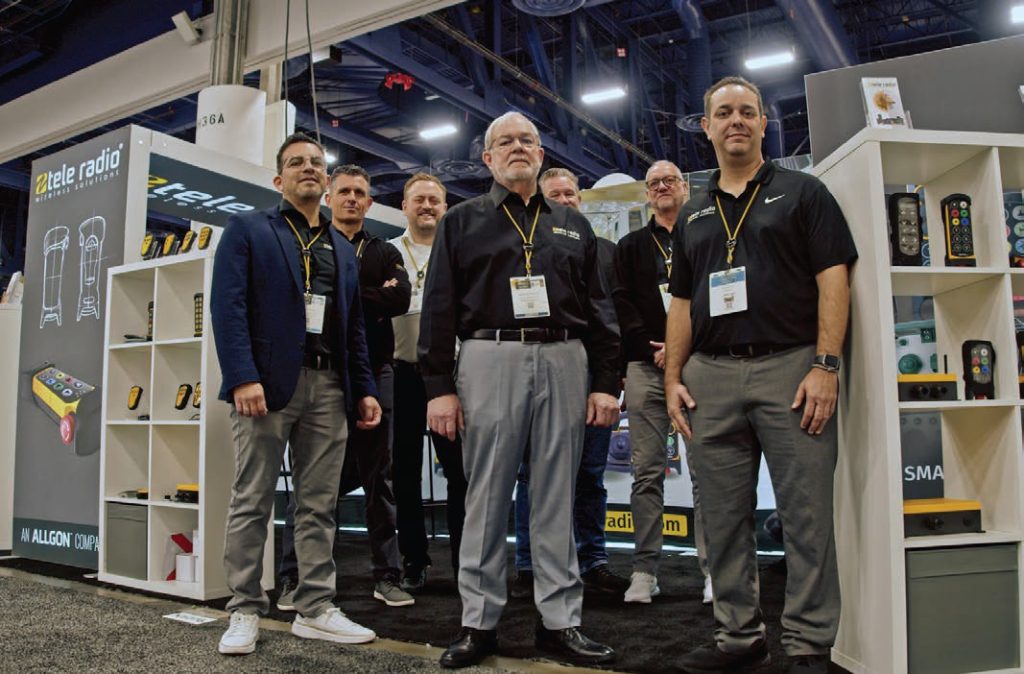
So, in 2005 he became managing director – and sole employee – of the newly formed Tele Radio America. When he started the business there was no infrastructure, no team, nothing. He was one man, newly arrived in Miami, trying to build a business that could sell to the whole of the US, Canada and Latin America.
“For two years, I was MD, technical expert, logistics manager, sales manager, head of accounting, everything,” he says. “Now, under my oversight I have 35 people, combining our US operation and our subsidiary in Brazil. I am also still MD of Tele Radio Spain. I came here wanting to create a network of distributors in Latin America, too, so when I moved here, I was a European trying to adapt to both North American and South American cultures, all of which are totally different markets with very different mentalities.”
Over the past 20 years, Tellez has succeeded in growing the Tele Radio family – the operation in Miami now has more than 170 employees and he has further expanded his role. Since 2018, he has been the company’s director of worldwide subsidiaries.
Have there been some lucky breaks along the way? Possibly. But as the stoic philosopher Seneca once reportedly said, “luck is when preparation meets opportunity”.
“People often tell me I was lucky, but I have worked hard for it,” says Tellez. “Not all of the moves I made sounded like a great idea at the time.”
Cultural shift
Arriving in the US knowing only his future wife, with sole responsibility for setting up a new international arm for a successful business and no local business contacts to learn from, Tellez had to quickly get to grips with a very different culture. Fortunately, he is eager to learn and refuses to be rigid in his thinking.
“My greatest strength is that I am flexible and adaptable,” he remarks. “I could come to this country and think only in terms of how things worked in Spain or Sweden. I can’t apply the same approach to markets like Chile or Mexico.
This is a Swedish company, and we need to have some core values, but you have to adapt to each economy.”
One of the first things he noticed was a difference in approach to solving problems.
When technical issues arise, the Swedish mindset immediately looks for a technical solution. For example, if a copper component is performing poorly, the approach would be to redesign it using a new material like gold.
The approach is to just do it and work out the cost issues later. On the other side of the Atlantic, a more measured but pragmatic route is likely to be taken.
“In the US or Latin America, the customs and ways of doing business are different,” Tellez says. “One thing that I noticed in the US compared to Europe is that the people here are very pragmatic.
I was surprised because I had an image that the US was extremely professional with high-tech and corporate thinking, but I found that customers were really open and welcoming, especially the local workshops or small and family-owned companies.”
“In Spain and Europe in general, it was usually hard to get an appointment, and we would only get 30 minutes to show what we had and could do. Over here, it is much easier to get that opportunity [in the Americas]. We have always been welcomed, and people have appreciated the opportunity, even if they did not buy our products. I have always liked that.”
The other stark difference is that parts of Europe, particularly Spain, effectively shut down in the summertime. Everything stops for a holiday. In the US, if there is an issue you solve it, whether it is summer or not.
“If you are not there to give them the solution, customers will find someone else,” Tellez remarks.
“I think the same way. You need to be there to deliver in the US, but that is in line with how I work anyway. I can’t sleep if I have a problem that needs to be fixed. My family had to adjust because I was working all the time, and even now my phone is always on so customers can call me any time of day, any day of year.
Finding a family
When he talks of family, Tellez means more than his wife and children, though they remain the most important motivations in his life. He also means the team he has built around him and the people to whom he can delegate key tasks because he now has the right level of trust.
“Many times, I have put family second and the business first, especially at the beginning,” he says. “In the first year here, I put 100% of my energy into the business. I adapt to what I see around me – a new market or a new role – and I am always learning.”
Delegation was not easy for him in the early days, and he believes his greatest weakness was probably the need to control every aspect of the business.
“When you hire people, you can’t tell them how to do everything,” he says. “That is not a good business model. I was a control freak in the beginning, so I had to hire the right people and oversee them for a while, and if they were a good fit then I had to let them do more and make their own decisions.
“I had to support them and help if they made mistakes, but I did not want them always thinking ‘what would Miguel do?’ It comes more easily now. The best thing I have done for the company is finding the best people. That is the biggest difference you make – find the right people for the right positions. Now, this company is a family – we share the same passion for making the company successful and being committed to customers.”
Tele Radio now sells its products all over the US and across the continent, and Tellez has been able to bridge the different mentalities and cultures that now live in the company’s DNA.
That has helped it to transition from a family owned business to a fully international company with a corporate culture, while still maintaining its original values of being reliable, close to customers and always available.
If a customer needs a product, it will be sourced right away. If it can be produced in-house, it will be fabricated overnight and delivered next morning.
“If there are problems, our response is to do everything we can to solve them because a customer’s problem is our problem, too,” says Tellez. “The difference between a good company and a great company is that when things go wrong you prove you are there, and you sort it out.
“Ask anyone who knows me, and they will tell you I am a man of my word. I commit to what I say, and I always come through. That is imprinted at the core or our company, in our DNA. That is why customers stay with us forever.”
Through thick and thin
The founder of Tele Radio once told Tellez, “We don’t sell products, we sell a good night’s sleep.”
Those words have stuck with him and reflect his approach to business and everything else in life. Work is not about making a quick buck but selling the right solution so everyone can rest easy.
Sticking to that core value is especially important when the future is uncertain. For better or worse, the economy is shifting, as the US works to reshore manufacturing jobs and global powers compete for power in international trade flows.
“I would say there are big opportunities and big challenges,” says Tellez. “Left or right, we all agree that we want to see manufacturing succeed in the US, but it is a challenge right now because of the uncertainty we are living through. Things were changing really quickly – hour by hour import tariffs with Canada or Mexico were changing.
Extreme uncertainty is not good for business, but when there is a more reliable guideline it will allow the whole market in the US to move forward.”
Whatever the prevailing market conditions, Tellez remains positive – it is in his nature.
Whatever the challenge, he and his team will meet it head on.
“I was surprised by how open and welcoming people have been here, and I have seen that the personal connection is very important – sometimes more than a price discount – and relationships go beyond just business,” he says.
“Everything becomes a family – employees, customers, OEMS and, in some cases, vendors.” “We are all in the same boat and hav e to row in the same direction. Sometimes if people have been doing things a certain way for y ears, they don’t see a need to change, and I would like to see that mindset change. Fortunately, I do see that openness in the younger generations.”
His mind may still stray back to the decision he made at college between becoming a professional triathlete or going into industry, Tellez has no regrets. He has been able to excel in both sport and business, not only through his willingness to step up to a challenge, but also his ability to adapt to overcome any obstacle.
In an uncertain world, those are qualities that will serve him and the Tele Radio family well.


