

Thanks to its central location in the Midwest and its status as a major intersection for national transportation, particularly in Indianapolis, the state of Indiana is known as the ‘Crossroads of America’. The ‘Hoosier State’ – so called because of a nickname for its residents that has stuck since the 1830s – has an extensive transportation network, including major interstate highways and railroads. For the materials handling sector, there could almost be no better place.
While no one can say for certain what the term Hoosier means, its association with rough-and-tumble pioneers, or hushers, is not something that is rejected by the locals, even if it comes with an image of unpolished, rough, or rowdy backwoodsmen. The friendly, downto- earth, and community-oriented values with which the state is associated and the strong sense of ‘Hoosier Hospitality’ are all tied up in the same proud origins. The deep-rooted culture of Midwestern values, with a strong focus on family, faith, and hard work, has changed little over time.
At a time when there is much focus on bringing manufacturing back to the US, Indiana is well placed to benefit. It is one of the most manufacturing-intensive economies in the country. Indeed, factories already account for a larger share of state GDP and employment than almost any other state, and that capacity spans many key industries – automotive, steel, aerospace, advanced materials, pharmaceuticals and more.
The Indiana Economic Development Corporation (IEDC) reports that the state has the highest percentage of manufacturing jobs in the US. More than 540,000 people are employed across automotive, aerospace, primary metals, machinery, chemicals, plastics and medical device manufacturing. Furthermore, it is the country’s biggest producer of steel – more than a quarter of US steel is made there – and it is home to many major automotive companies, among them GM, Toyota and Subaru. Eli Lilly and other global pharmaceutical companies have also made it their home.
Its business tax climate is also highly attractive and a key economic driver. Indeed, the Tax Foundation’s 2026 Business Tax Index shows the state as 10th in the nation on its tax competitiveness index, and best in the Midwest. It has a flat 3% individual income tax rate, 4.9% corporate income tax rate, 7% state sales tax rate and 0.77% effective property tax rate on owner occupied housing value. Furthermore, there is no estate tax or inheritance tax.
“Our favourable tax climate is clearly a key component of Indiana’s business-friendly environment,” says Indiana Chamber president and CEO Vanessa Green Sinders. “But our diversity of industries, centralised location and abundance of higher education institutions fuelling innovation are key contributors too. Our legislative leaders are generally businessfocused as well, having recently created the Indiana Office of Entrepreneurship and Innovation, largely to help our main street businesses thrive, as just one example.”
“Companies and site selectors often have Indiana on their radar and the Indiana Chamber is pleased to have played a major part in building that climate,” she adds.
The rich history of hoist
The state is taking a very forward-looking approach to attracting investment. It is targeting $1trn in investment from tech companies over the next five years, $13bn of investment in the development of battery technology for electric vehicles and further fuel to build on its leading position as the biggest exporter of pharmaceuticals in the US.
“Indiana’s economic climate today is stronger than its Midwest neighbours, thanks to powerful growth in manufacturing and pharmaceuticals,” says Jon Harkrider, VP of sales at Hoosier Crane, the largest Indiana-based crane company. “It is stable but slowing. Growth continues, but at a more modest pace than recent years.”
Tariffs and trade volatility are driving up costs and, to some extent, hurting employment momentum. Life sciences and AI infrastructure are giving the local economy a welcome boost, but they cannot offset manufacturing headwinds alone. Nevertheless, the state is not about to enter a recession. Forecasts for 2026 show continued, albeit slower, economic expansion for Indiana.
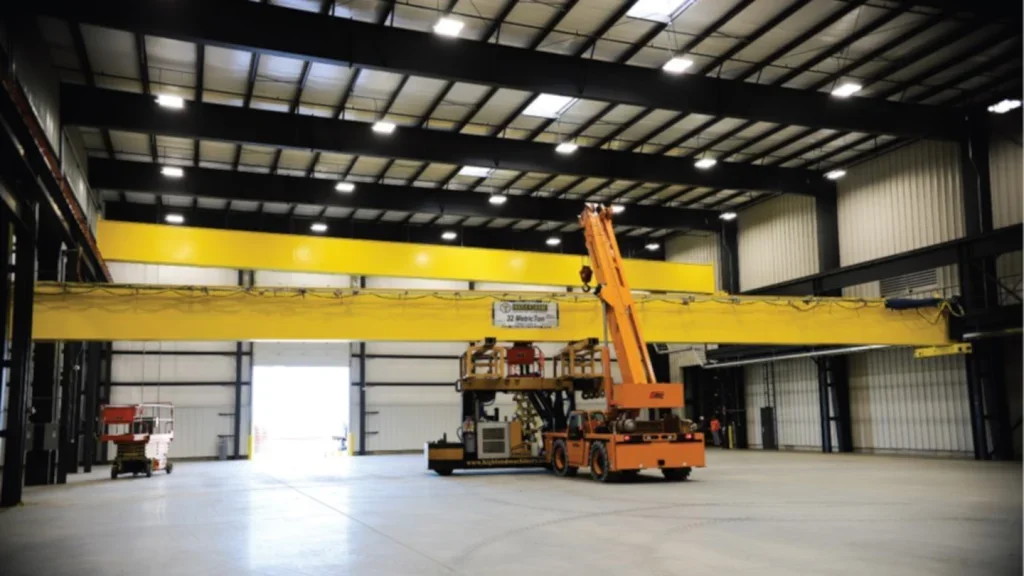
Hoosier Crane, headquartered in Elkhart, Indiana, but operating across the region, is a family owned, full-service manufacturer of overhead cranes, jib cranes, gantry cranes and monorail systems, and also provides extensive services such as crane inspections, operator training and the supply of parts. With annual revenue of $50m in 2025 – it is the only Indiana crane company with publicly reported revenue – 120 employees, and full in-state manufacturing capability, it is a prime example of how the crane and hoist industry has prospered in the state since the start of the 20th century.
Indiana has a long, diverse industrial heritage, and overhead lifting equipment has been part of that story for more than a century. The state’s lifting-equipment ecosystem grew from early 1900s foundries and machine works into today’s full-service crane manufacturers, fabricators and service companies.
The foundations of the state’s crane manufacturing industry go back to the early 1900s. Its roots go back to companies such as Bedford Foundry & Machine Co., which was established in 1902. The predecessor to Bedford Crane Service, it began as a manufacturer of early overhead electric travelling cranes under the name Bedford ‘Loadmaster’. Later connected to Indiana Steel & Engineering Corp., the company became one of the earliest producers of large capacity overhead cranes in the state.
Founded in Indianapolis in 1907, Insley Manufacturing Co. ultimately became a major Indiana manufacturer of heavy construction equipment, most notably cable-operated digging machinery such as power shovels and draglines. Though its focus was predominantly on excavating equipment, its technological developments – among them cable systems, heavy mechanical structures, power-driven machinery – played a key role in influencing the broader development of industrial lifting technology in the region.
In 1924, Bohl Crane began selling simple monorails before evolving into a multi-division company producing specialised monorails, engineered lifting devices and custom cranes, serving the Indiana region.
By the middle of the 20th century, Indiana’s manufacturing boom had created strong demand for overhead cranes in industries such as automotive, steel, transportation and fabrication. Started in the 1950s, Huntington’s Orton Crane Company was a notable supplier of industrial lifting equipment for local factories.
Brehob Corporation, established in 1953 in Indianapolis, became one of the state’s long-standing crane suppliers, providing bridge cranes, parts, emergency services and OSHA-compliant inspections. Later, in 1962, Indiana Steel & Engineering Corp. appeared as a fabricator of buildings, bridges and overhead cranes, continuing the lineage of Bedford’s crane manufacturing expertise.
In the 1970s, the strong undercurrent of modernisation led to the appearance of more specialised crane companies. Among the dedicated overhead crane manufacturers and service firms that were notable across the state were T&M Cranes, founded in 1974, as a family owned company providing overhead cranes, hoists, parts, modernisation, repair and engineering services throughout Indiana.
As Indiana’s industrial base continued to diversify, it fuelled further growth among local crane fabricators and service providers, with many crane-focused companies emerging around Indianapolis, Fort Wayne, Merrillville, South Bend and the Elkhart-Michiana manufacturing corridor. The further rise of full-service crane companies across the state took hold in the late part of the century, with many companies emerging as significant regional providers of overhead cranes, hoists and material-handling systems.
Industrial Installations, founded in Mishawaka in 1986, specialised in fabricating and installing bridge cranes, jib cranes, monorails, hoists, spreader beams and lifting devices, eventually becoming a regional leader in overhead crane systems. Currently, Crane 1 Services in Indianapolis is a notable provider of custom runway systems, repairs and OSHA inspections.
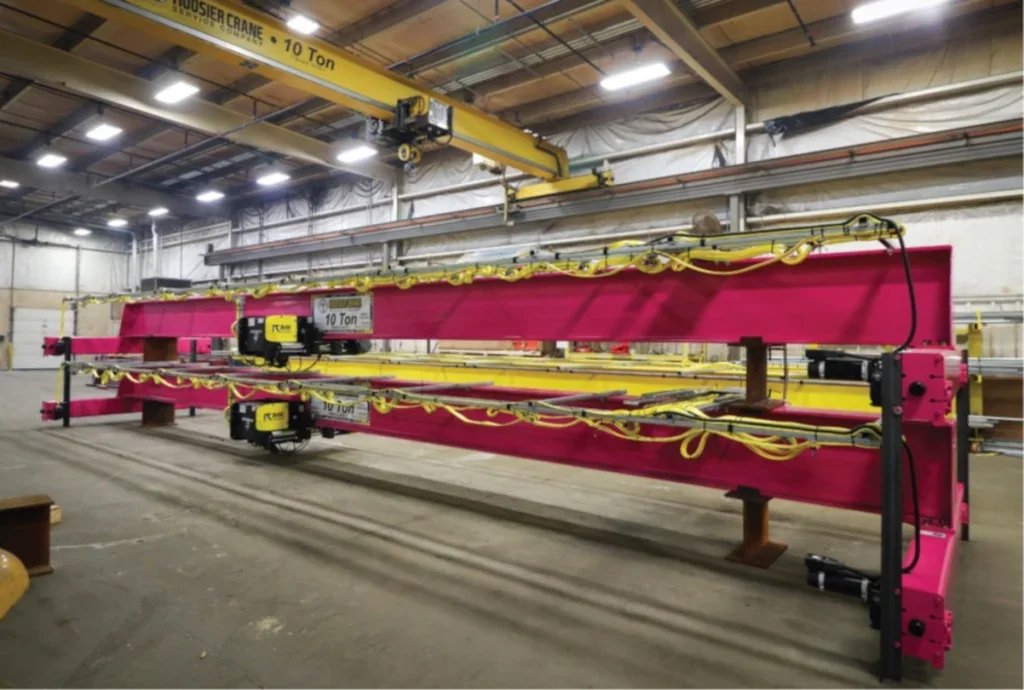
CraneWerks was established in 1997 in Morristown. Today, it works with an independent dealer network to supply overhead cranes and related lifting equipment for commercial and industrial applications nationwide. Its product range includes bridge cranes with capacities from half a tonne to 80t and spans up to 104ft, manufactured in single-girder, double-girder and box-girder formats. It also continues to provide equipment installations, upgrades and services in cooperation with partner firms through its dealeronly network across the US.
In the 21st century, Indiana continues to be a major Midwestern hub for overhead lifting technology and modern material-handling solutions. Hoosier Crane Service Co., founded in 2002, now serves both statewide industries and a nationwide customer base for new crane installations and parts. It builds box girder cranes for its own customers and for other crane dealers and also operates as a master parts depot for most brands. From its four locations it covers all of Indiana, as well as parts of Ohio, Michigan, Illinois and Kentucky.
Indiana remains one of the strongest states for overhead crane manufacturers, distributors and service organisations, which is thanks to its varied industrial base, and the overhead crane industry density is among the highest anywhere in the nation.
A hotbed for major projects
The many advantages of operating in Indiana – low corporate income tax, low personal income tax, the low cost of living to attract employees and its strategic location – have helped the state’s economy to remain one the strongest in the Midwest. Furthermore, it is a right-to-work state, meaning laws have been enacted to ensure that employees are not required to join a labour union or pay union dues.
There are plenty of big projects creating demand for crane and hoist services, not least those arising from the ongoing expansion of the manufacturing sector in general, which already accounts for more than 25% of the state’s Gross Domestic Product (GDP). Advanced manufacturing alone accounts for roughly 26% of all economic activity in the state.
Nevertheless, there are certainly challenges that are holding back faster growth, and Harkrider is quick to point to lower fuel prices, reduced tariff instability, faster introduction of new technologies and more investment in workforce training and talent attraction as key factors that would stimulate growth.
The talent issue is of particular concern. The available workforce is shrinking, with the number of skilled trades people in sharp decline. Many people with industry knowledge are ageing out and retiring.
To address this issue, Hoosier Crane has started its own State-Accredited Youth Apprenticeship Program to provide paid on-thejob training, mentorship from industry experts, industry certifications and a direct pathway to full-time employment. The aim is to open up real opportunities for long-term career growth in a way that strongly aligns with Indiana’s state workforce initiatives.
The impact of this programme, which is heralded as one of Indiana’s strongest employerled apprenticeship pipelines in the industrial trades, has been to strengthen the internal talent pipeline and improve culture, retention and team collaboration. The state is working hard to expand high-school apprenticeships to 50,000 students by 2034, and Hoosier Crane has taken concrete action to be among the leading industrial employers supporting this movement.
As graduates secure long-term technical jobs in a growing industrial sector, with clear advancement paths, the industry as a whole not only builds out its talent pool but positions itself as a credible source of high-skill, highwage careers.
While it helps to build the skills the industry requires to continue prospering, the company has maintained an impressive roster of projects. In 2026, it is installing new cranes for an airplane hangar. The site has 3,456ft of runway, and the Hoosier Crane is supplying two 276ft 5t under running cranes with 75ft of lift and one 20t double girder top running crane. Elsewhere, it has built two spliced box girder cranes for shipping to the Cayman Islands, and five box girder cranes with runways in South Dakota.
“We are building close to a box girder a day,” says Harkrider.
CraneWerks is another company that is involved in significant projects. In late 2025, it installed a 95ft-long, 35t box girder crane for an industrial client. The installation process required coordination between the company’s installation and service teams, who managed electrical integration and maintained ongoing communication to address safety requirements.
The installation of the box girder crane was complex for many reasons. Firstly, due to the weight of the girders and restricted headroom at the site, several months of preparation were required. The company partnered with Indiana based Muck’s Crane and Contracting to conduct the heavy lifting operations that were necessary for this project. At the same time, CraneWerks was involved in upgrading the running gear on the client’s vacuum cart as part of its service provision.
“Most importantly, I’m grateful for the employees who are out in the field during the holidays – taking time away from their families to get the job done safely and correctly,” said CraneWerks strategic solutions and key accounts director Matthew Fuller. “That level of commitment doesn’t go unnoticed and is a big part of what sets this team apart. Proud of the crews involved and thankful for partners who help make complex work look routine.”
The previous month, the company installed a 25t overhead crane at a site in Virginia.
Clearly, the industry is in good shape for now, and the prospects for further growth in the all-important manufacturing sector are positive. The state certainly has ambitious plans to attract more investment in key sectors such as pharmaceuticals, and there is a plan to attract more investors in hi-tech industries.
Indeed, embracing advanced technology and automation will be essential for the state’s big manufacturing companies to remain competitive. There are signs that Indiana’s manufacturing sector is moving rapidly to adopt AI-enabled production methods and robotics. Indeed, there are state programmes, not least the Regional Economic Acceleration and Development Initiative (READI) programme, and a number of manufacturing training grants available to support companies in their transition to smart factory models.
Indiana’s manufacturers will also play a key role in the future development of the electric vehicles supply chain, delivering EV components and technologies for hybrid and fully electric models. Expansion in the aerospace and defence sectors also continues, with companies such as Rolls-Royce building out their operations in Indianapolis, and Raytheon Technologies investing in the production of advanced radar, avionics and electronic warfare systems for national defence programmes.
To benefit from this, it is essential that the state’s crane and hoist companies continue to invest in the next generation of skilled workers, as Hoosier Crane is doing. The potential is there for the industry to prosper, but without a way to capture the skills and experience of a generation of workers that is coming up to retirement, it will be hard to capitalise on that opportunity.
Indiana has no shortage of people who relish hard work, so the challenge is to make sure the next generation appreciates the value of skilled trades.


