
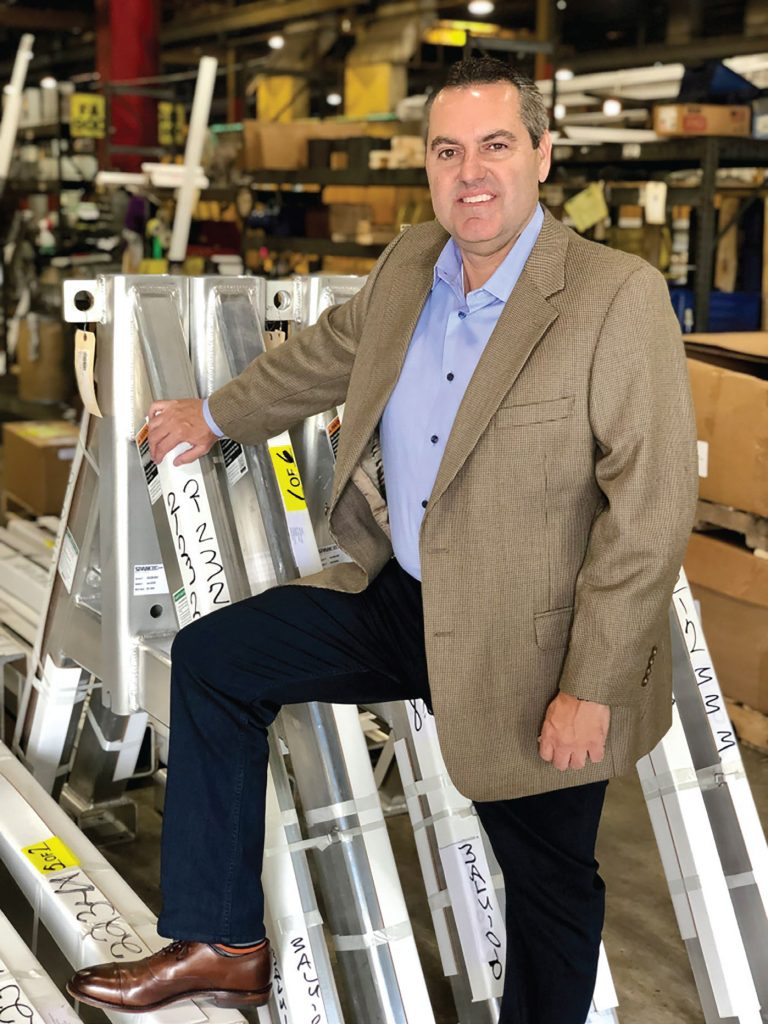
There is a myth that many people around the world like to believe about Americans – they don’t like to travel outside their own country and they have no interest in any language other than English. This often goes hand-in-hand with another untruth – that very few Americans hold passports because they don’t travel outside of the US. Jeff Brazwell, president and CEO of Spanco, is happy to lay these falsehoods to rest.
From an early age, he found himself curious about other cultures and languages, and though the spark for this curiosity came from an unlikely source, it has fuelled many of the major choices that led him to his current role at the head of one of the leading American manufacturers of overhead material handling cranes and lifting solutions.
“I was inspired by a terrible teacher in eighth grade who showed us documentaries about ancient cultures,” he explains. “Most people in the class just slept through it, but I was fascinated.”
This led to his keen interest in learning foreign languages and despite having no clear idea of what he wanted to do when he grew up, the child in Brazwell was certain that international travel would be a key part of his career, not least so that he could put into practice his skills in Spanish and Portuguese.
“I always liked the international market and the chance to see other countries and cultures, so I learned languages and travelled a lot,” he says. “I wanted a job that would connect me to that and I was lucky that, when I got out of college and took a job in the paper industry, an opportunity came up to transfer to be export manager because of my language skills. That was at the age of just 24, and I was the youngest manager in the company at the time.”
“Stereotypes exist for a reason but to the extent people think that Americans don’t leave the US or learn foreign languages – I would say that it is not true,” he adds. “Maybe 30 years ago fewer Americans had a second language, but more and more do now, and more of us travel abroad.”
Following the paper trail
Brazwell’s start in the paper business came after he graduated from the University of West Florida with a degree in marketing. He left knowing only that he wanted to go into sales and marketing, and in 1992 he took a job at paper distributor Unisource Worldwide.
Soon he was managing sales and export logistics operations in the northern half of South America. Clearly the job suited him well, as he increased sales by 474% in the first two years from $2.98m to over $14m. From there, he switched territories and began developing business in Brazil, Argentina and Chile, growing sales from zero to over $3m in less than two years.
“I was selling massive amounts of paper all over Latin America. I liked that job, the product and the people, but the industry was very volatile, and even 30 years ago I could foresee that paper consumption was going to decrease with the advent of the internet and digital media,” says Brazwell.
This foresight led him to move first into selling machinery for the paper industry, then into a job at R&M Materials Handling, part of the Konecranes Group, selling crane components and hoists. Once again, his affinity with foreign languages and cultures was crucial in enabling him to grow the company’s business. The other major ingredients were sheer hard work and determination.
When he started at R&M, the company had no sales in Latin America, but in a short few years Brazwell was able to develop a large distribution network throughout the region.
“Back then, I was just one man with a briefcase full of brochures. This was before cell phones and GPS were available to the average business traveller. I used to find potential distributors in the Yellow Pages, call them from the hotel phone to set an appointment, then find my way to their office in a rental car using a paper map.”
While he had no specific vision for where he wanted to end up, he found that a strong appetite for hard work was enough to open many doors.
“I had no clear plan but I found that opportunities were opening up as I went along,” he explains. “I like tangible products and I knew I did not want to sell services or work in retail, but other than that I was fine in almost any industry with a real product I can touch, see and understand.”
In 2014, that drive – coupled with a keen eye for the next big opportunity – led him to Spanco. “I really saw the potential in this company. Now, many years later, and as a co-owner, I can still see even more potential and I am determined to make it a reality.”
The Spanco story
Before Brazwell joined the company, Spanco had already charted a long trajectory of growth that had begun in 1949 when George Uhlig, the father of founder Richard Uhlig, invented the first truly safe cable lever ratchet hoist. Today, Lug-All manual hoists are still used worldwide.
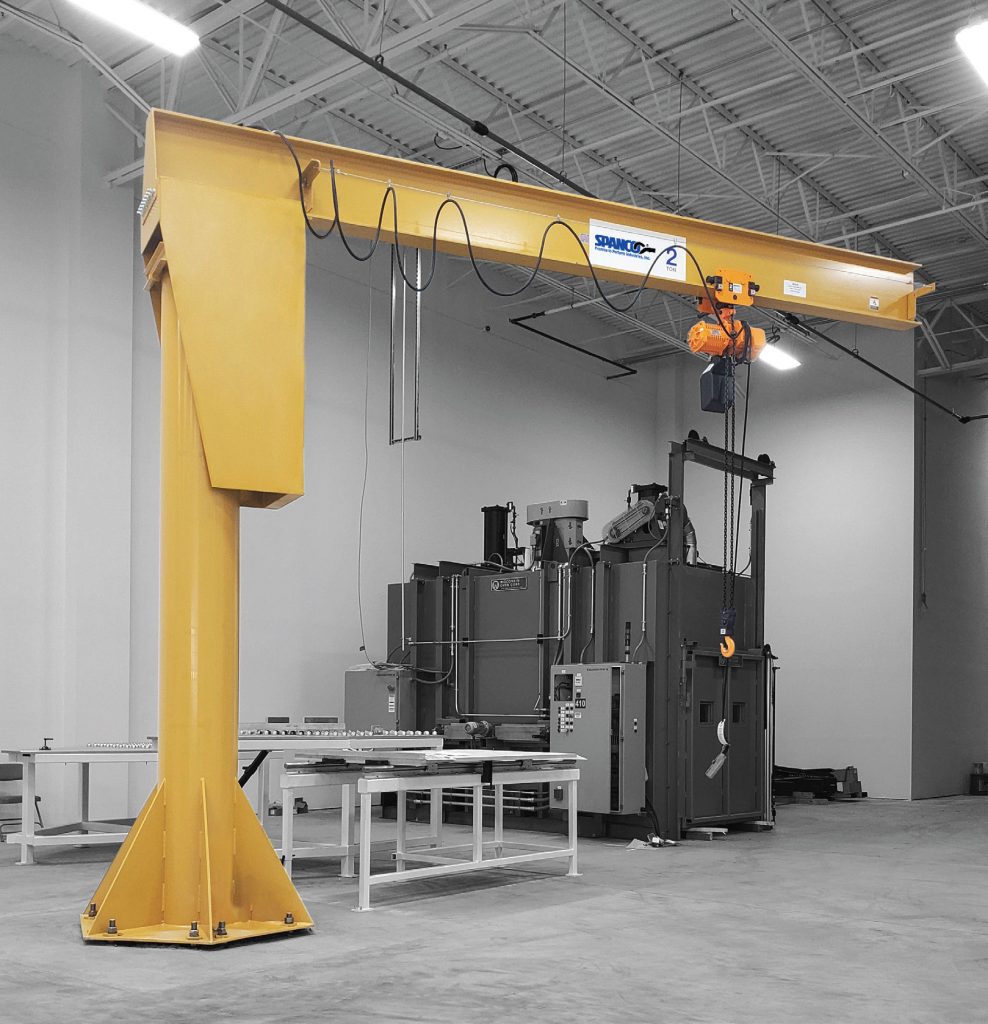
Fast forward 30 years to 1979, and Richard Uhlig forms Spanco in Downingtown, Pennsylvania, which initially manufactures a small line of Spanco adjustable gantry cranes and tripod cranes. Later, as the business grew, Spanco jib cranes and workstation bridge cranes were added to the portfolio.
In 1992, the company invested in a 95,000ft2 manufacturing facility on the edge of Pennsylvania’s Amish country in Morgantown, where the company’s headquarters and its core manufacturing facility are still located. The product offering continued to expand with workstation cranes that in those days used imported track from Helm in Germany.
In 2005, the expansion continued with the introduction of rigid track fall protection systems under a new Rigid Lifelines division, and the company’s engineers soon developed a line of Spanco Tractor Drives for I-beam and enclosed track systems, as well as retrofit drives for jib cranes. Three years later came another big investment, this time in a major manufacturing facility in Las Vegas, Nevada, which served not only a key marker of the company’s growth, but also a key hub for serving customers on the West Coast.
Five years later, that facility would double in size in order to keep pace with growing demand. The following year, Brazwell joined as vice president of sales, playing a crucial role in setting up an extensive dealer network in Latin America over the following two years, during which time the company added several new regional sales managers in the US and Canadian markets. In 2020, the Spanco Zip-Ship Freight Estimator, Fast-Track Program and Rigid Lifelines Online Configurator were launched, marking the culmination of a period of intense innovation.
Throughout this time, Brazwell and other senior executives had sensed an opportunity opened to fill a gap in the leadership team and take more direct control of the company’s strategic direction.
“The absentee owner was spending most of his time in Florida and he wanted to pass the business on to his son but that did not work out so well,” he remarks. “So, he stepped back from the business and we saw our opportunity. We approached him about taking over but the process was slow. It was slowed down by Covid but the real issue was that it was hard for him to let go of a long-held family business.”
Nevertheless, in 2021, the management buyout by Brazwell and two business partners was finalised, and all assets of Spanco, Lug-All and Rigid Lifelines were transferred to their holding company Promise to Perform Industries, Inc. The move represented a bold new start for the business, but like many of the best ventures it did not set sail on calm seas.
“In our first year of ownership we faced many headwinds – the pandemic, supply chain shortages, inflation, employee turnover from the Great Resignation and many scheduled retirements, and many other challenges. Nevertheless, we came out stronger because it forced us to make a lot of tough decisions faster than we would have otherwise done,” says Brazwell.
“The predecessor company under the previous owner was on auto-pilot in many ways and we had to invigorate it. It had ‘good bones’ in terms of its products, but many other aspects of the business needed shoring up. Now, almost five years later, it is like a brand-new company – growing, vibrant and very profitable.”
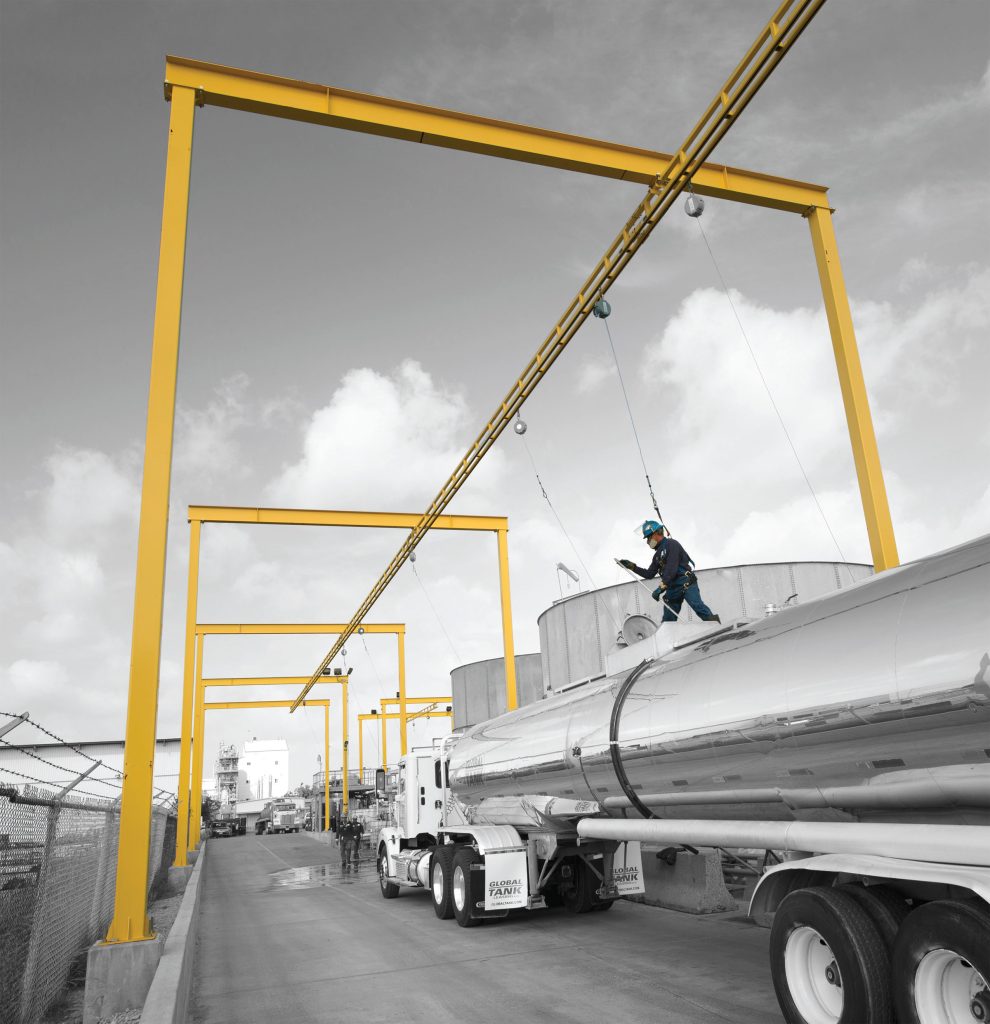
Today, Spanco is one of the industry’s leading manufacturers and is recognised for designing and building high-quality, customisable overhead material handling cranes and lifting solutions. Its durable jib cranes, gantry cranes and workstation bridge cranes are used in a wide array of industrial sectors that require lifting systems that are both ergonomic and efficient.
“The opportunity to buy the company came along when it did and we didn’t have much choice but to go ahead with it during the pandemic,” he explains. “It was a challenging time for us as new owners, and it was my first time being the president and co-owner of a company. I knew we had good people and good advisers around us, but all of the challenges that businesses must deal with were all compacted into the first year of our owning it.”
Adversity kills you or makes you stronger, and in Brazwell’s case it was certainly the latter. Supply change shortages meant that many components were very hard to get, but Spanco never ran out of anything vital. The closest it came to a shortage of inventory was when it had enough paint for only one or two days.
“We always found a way to make it,” he says. “We didn’t rely on one vendor. For anything critical, we always have multiple vendors, and this helps with negotiating prices down and ensuring supply. Inflation was a problem – and still is to some extent – though some of the inflation of employee wages and benefits was our choice because we wanted to create employee loyalty and attract a better calibre of people.
“That is important to us but it does hit the bottom line. It has improved employee turnover – to the point where we have almost none now – but we had a lot of people of retirement age who hung up their boots when the pandemic came.
Around 10% of the workforce retired, but we dealt with that. Every problem is an opportunity.” In that adversity, Brazwell and his partners took the opportunity to look at every aspect of how the company operated. What they found were many positive fundamentals, and a solid platform for future growth. Coupled with a naturally optimistic outlook and an entrepreneurial spirit, that is a powerful mix.
The power of positivity
By nature, Brazwell is a positive and forward looking person. He has a faith in the future that has been fuelled by the path his career has taken.
“My positivity is borne out through my own experience. Over my career, everything has worked out somehow, even if it was not always how I expected. But one of the jobs of a leader is to see the future, to see where you want to go, to devise a strategy to get there and convince people to come with you on that journey.
Unless you have confidence, people will not follow you, so you have to believe there is a better future out there.”
Spanco has taken practical steps to adapt to the changing marketplace. It has embraced technology, invested in educating its workforce, reinvigorated its culture and its sales team to provide an industry leading customer service experience and consistently added new products. For example, it was a leader in introducing many fall protection products to the market.
That commitment to embracing change will be crucial in the years ahead, as Brazwell sees the industry becoming much more competitive. He expects more companies to enter the sector, and the consolidation of crane builder companies and crane components manufacturers to continue or even accelerate.
“In terms of technology, I can even imagine the merging of material handling equipment with other production equipment like robots as these become more prevalent. And we have only scratched the surface of AI and its transformational potential. And we will deal with whatever we are faced with economically. You have to dance to whatever music is put on. You can’t always change the music, so you have to learn to adapt,” says Brazwell.
“The biggest challenge is always uncertainty. No business likes that. Things are somewhat unpredictable now and that is not a good thing because business likes stability. We can adapt to import duties, for example, as long as the rules are clear and we understand them. For now, we are booming – we almost can’t keep up with demand.”
Despite his positivity, Brazwell is still realistic. He freely admits that the industry, like many others, faces a potential labour shortage that cannot be fixed overnight. Many experienced workers are close to retirement and there are simply too few qualified younger people to fill the vacancies they will create. There are certainly ways to bridge the skills gap, but perhaps not fast enough.
“As a country we could invest more in trade schools at state, local or federal level,” says Brazwell. “That would be a big help. We need to feed more people into the system and that might require an immigration system that targets people with the skills that are in short supply.”
For his part, he is working hard to ensure that Spanco has a system of training, both internal and external, that will deliver the right skills to the organisation. The company is partnering with local trade schools and allowing some employees to work part-time while attending training courses. Last year, around one-third of employees engaged in some kind of external training.
“If you count internal training, then almost everyone in the company got the benefit,” he adds. “The real path to making more of yourself and making more money is to take on more responsibilities, and we prefer to promote from within and give employees opportunities for advancement.”
And therein lies the real gem at the heart of Brazwell’s philosophy, which he sums up as “lifting others up”. In his five years at the head of the company, he and his team have intentionally changed its culture to create a positive environment in which people can grow.
He sees his job as being that indispensable link between what others aspire to and where they currently are. For an employee, that may mean teaching or coaching them, or perhaps just giving them an opportunity to take on more responsibility. For a customer, it might mean providing them with knowledge, tools or products to help them grow their business. For a vendor, it could be collaborating for mutual gain.
“Whenever we focus on and help others, it is always a virtuous cycle that returns the favour back to us,” says Brazwell. “I have had many mentors throughout my career without whom I would not be where I am today.”
When the leader of the company embodies the can-do spirit that he asks of his colleagues, and consistently models an internal desire to constantly improve and excel, the whole organisation follows.
“I expect a lot and have high expectations for myself and all of those around me. I have these high expectations because I believe in others’ ability to achieve great things, and I am here to help them.”
That is as firm a foundation for success as you will find anywhere in this industry.


